Trump Administration Cheers Plastic Surgeons' Stance on Trans Youth Surgery
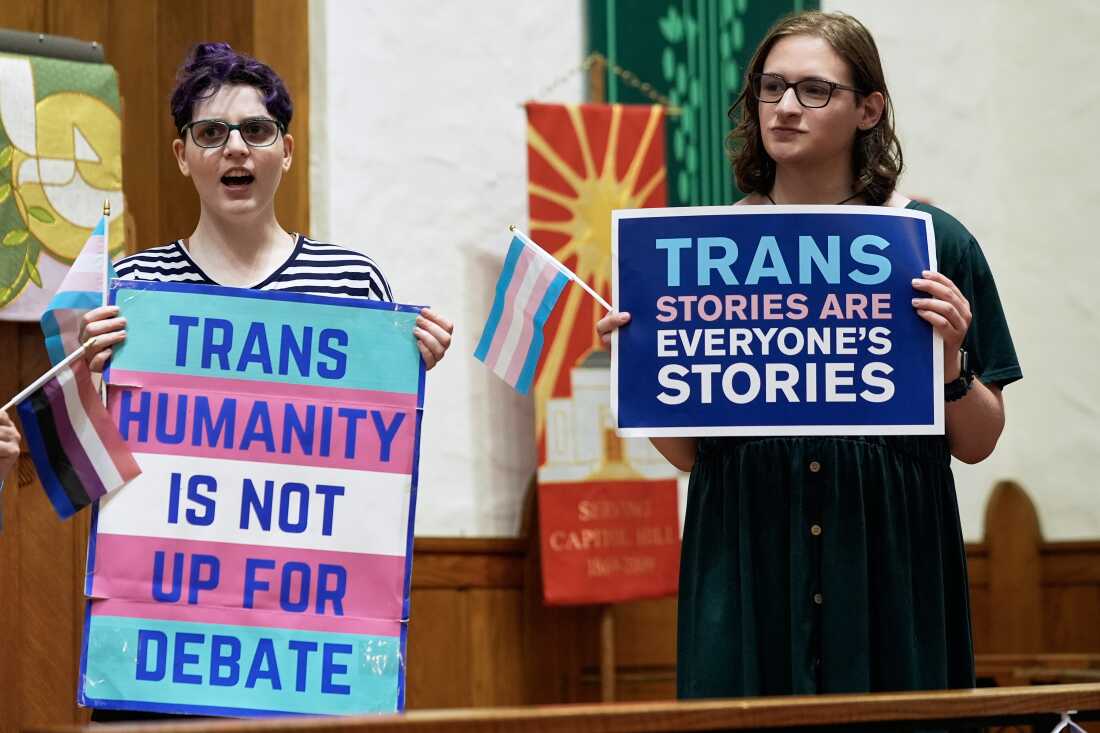
Supporters of transgender rights gathered at the Lutheran Church of the Reformation in Washington, DC, following the Supreme Court's decision to uphold Tennessee's ban on gender-affirming care for minors in June 2025.
The Trump administration expressed approval of a recent statement from the American Society of Plastic Surgeons (ASPS), which advises that gender-related surgeries should be postponed until patients reach at least 19 years of age.
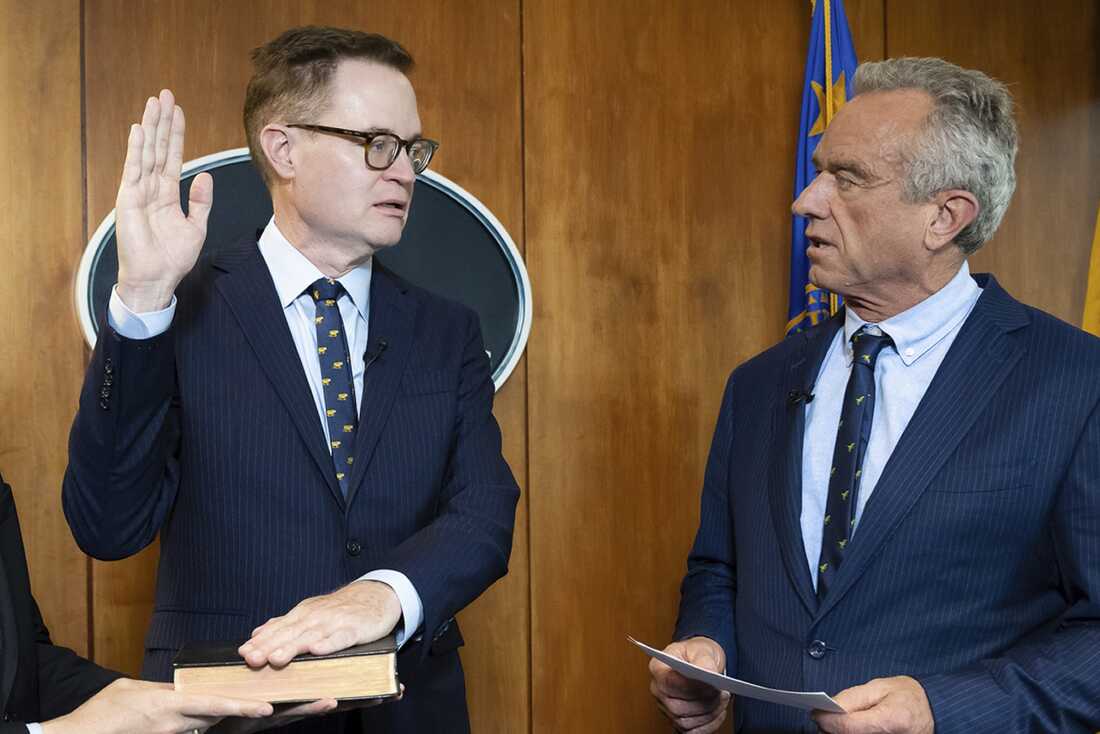
"Today marks another victory for biological truth in the Trump administration," stated Deputy Health and Human Services Secretary Jim O'Neill in a press release. "The American Society of Plastic Surgeons has set the scientific and medical standard for all provider groups to follow."
In correspondence with NPR, ASPS clarified that this new position is not a reversal of its previous stance. Rather, it serves as an articulation of recommendations based on current evidence and the varying legal and regulatory landscapes.
This landscape is complicated by 27 state bans and a federal administration intent on curtailing surgeries and other forms of gender-affirming care for minors nationwide.
Shortly after beginning his second term, President Trump enacted an executive order stating: "It is the policy of the United States that it will not fund, sponsor, promote, assist, or support the so-called 'transition' of a child from one sex to another, and it will rigorously enforce all laws that prohibit or limit these destructive and life-altering procedures."
Since then, HHS has released a report criticizing research supporting access to gender-affirming care and cautioned state Medicaid directors to proceed with caution. The Department of Justice has issued subpoenas to certain children's hospitals and threatened legal action against providers.
In December, federal health officials proposed a rule that would cut Medicare and Medicaid funding for hospitals offering gender-affirming care to minors. Although not yet finalized, the looming possibility of such a rule, coupled with numerous investigations by the HHS Inspector General, has led to the closure of gender clinics across the country.
In a related case this week, a patient was awarded $2 million in a malpractice lawsuit against her plastic surgeon and psychologist in New York after undergoing a mastectomy as a minor and later regretting the decision.
The combination of malpractice threats, state bans, and hospitals discontinuing gender programs has significantly reduced options for transgender teenagers seeking surgery—an outcome aligned with the White House's objectives.
A 15-year-old transgender boy in California shared with NPR that his plans for top surgery are currently on hold due to Kaiser Permanente ceasing to provide gender-affirming surgeries for youth. "It's not easy to do it out of pocket," he remarked, requesting anonymity for safety reasons.
He described the ASPS's new position as "disappointing," noting that the Trump administration recently sent warning letters to manufacturers of binders—compression garments used by transgender teens who opt not to undergo surgery. "Which is crazy because it's not like a binder is permanent. You can take it off anytime you want," he said. "I was going to ask, 'What do they want us to do?' But I think the answer is to detransition."
Data on how many transgender teenagers undergo gender-affirming surgery remains unclear. The ASPS recommends delaying breast/chest, genital, and facial surgeries until patients are at least 19 years old. Gender surgeries for individuals under 18 are uncommon, with most being top surgeries.
The ASPS does not track specific data on these procedures. However, one study indicated an average of 800 top surgeries annually among patients aged 18 and younger from 2016 to 2020. The surge in state-level bans on gender-affirming care began in 2022, leaving uncertainty about their impact on the number of transgender minors receiving top surgery.
Non-transgender minors also seek plastic surgery and face similar risks of complications and regret. In 2024, ASPS data revealed over 9,000 girls aged 19 or younger underwent cosmetic breast surgery, while nearly 3,000 boys under 19 had breast reduction procedures.
The ASPS's position on breast augmentation for teenagers similarly advises waiting until age 18 for surgery. "While both position statements address surgery in adolescents, the ethical considerations are not the same," ASPS explained in an email to NPR. "Cosmetic procedures are generally not dependent on future identity development or long-term psychological trajectories."
Regarding gender-affirming surgery for transgender youth, ASPS added that "interventions are irreversible, expected benefits are uncertain, potential harms may be lifelong, and patients are minors with evolving preferences and identities who have been diagnosed with a condition of unknown stability."
A mother from California recounted her experience with her son, who came out as transgender at age 13. She requested anonymity due to safety concerns. Initially unaware of trans issues, she sought therapy for both herself and her son. Over time, they gained a better understanding of his needs.
He expressed a desire for top surgery. "Like many parents, we were frightened about making the right decision," she said. "We told him no." After observing his struggles with binding and tape, they eventually agreed to explore top surgery when he turned 15.
"There are many requirements—it's not something you just go in and get—there is therapy and multiple meetings with different doctors," she explained. Their initial surgery appointment was canceled due to hospital hesitance, necessitating a rescheduling effort.
Now 17, her son had surgery two years ago, and she noted his positive transformation. "My only regret is that we couldn't have done it sooner," she said. "To think that other kids who might need this have to live in a shell is so unfair and makes me so angry and sad."
Following ASPS's statement and the Trump administration's endorsement, conflicting reports have emerged regarding the American Medical Association's stance on gender-affirming care.
The AMA affirmed its support for evidence-based treatment, including gender-affirming care, stating that surgical interventions for minors should generally be deferred until adulthood. This clarification does not signify a reversal or endorsement of ASPS's new position.
Similarly, the American Academy of Pediatrics emphasized that decisions regarding surgery should be made by doctors in consultation with patients and their families rather than dictated by politicians.
Notably, ASPS's recommendation aligns with existing standards of care for transgender youth, which advocate that candidates for gender-affirming surgery should reach adulthood—criteria that may vary based on location.
Kellan Baker from the LGBTQ think tank Movement Advancement Project remarked that ASPS's position felt redundant. "I'm looking at this and I'm like, 'OK, thank you for telling me that water is wet and the sky is blue,'" he commented.
Baker contended that framing this as a significant shift within the medical community benefits the Trump administration while ignoring the political pressures it has exerted to achieve such outcomes.