U.S. Military Targets Three Alleged Drug Smugglers in Latin America, Resulting in 11 Fatalities
On Tuesday, the U.S. military confirmed it executed strikes against three boats suspected of drug smuggling in Latin American waters, resulting in the deaths of 11 individuals. This incident marks one of the most lethal days in the ongoing campaign against alleged traffickers during the Trump administration.
The strikes, which occurred on Monday, have raised the total death toll to at least 145 since the administration intensified its focus on what it labels "narcoterrorists" operating in small vessels beginning in early September.
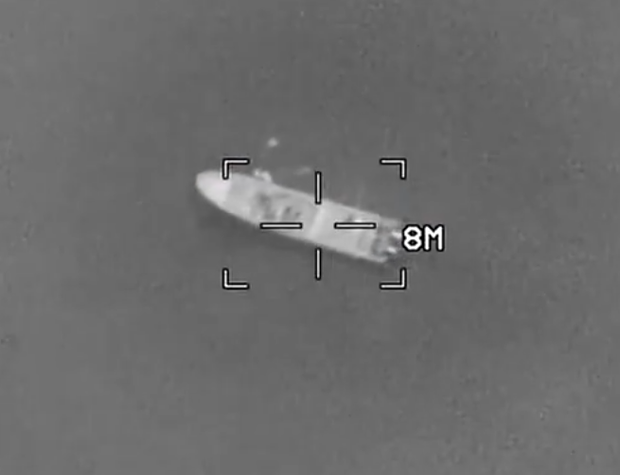
U.S. Southern Command reported that these operations targeted boats along established smuggling routes. Two vessels, each carrying four individuals, were struck in the eastern Pacific Ocean, while a third boat with three occupants was targeted in the Caribbean Sea.
Despite the military's assertions, no concrete evidence was provided to confirm that these vessels were transporting drugs. However, videos shared on social media platforms depicted the boats being destroyed.
Footage released by Southern Command captured the boats either navigating or floating before they were engulfed in flames. In some clips, individuals can be seen aboard two of the small vessels just prior to their destruction.
President Trump has characterized the U.S. engagement as an "armed conflict" with Latin American cartels, defending these strikes as essential to curtailing drug trafficking.
Critics have raised significant concerns regarding the legality and efficacy of these military actions. They argue that much of the fentanyl responsible for numerous overdoses is typically smuggled overland from Mexico, where it is synthesized using chemicals sourced from China and India.
The military's boat strikes faced backlash after it was revealed that survivors from an initial attack were killed in a subsequent strike. While the Trump administration and several Republican lawmakers defended this action as lawful and necessary, Democratic lawmakers and legal experts condemned it as murder or potentially a war crime.
Earlier this month, another strike targeted a boat allegedly involved in drug trafficking, resulting in two fatalities and leaving one survivor. A spokesperson from the U.S. Coast Guard indicated that Southern Command had reported a "person in distress," but efforts to locate this individual were unsuccessful.
These military actions coincide with one of the most significant buildups of U.S. military presence in Latin America in decades, part of a broader strategy that included the capture of former Venezuelan President Nicolás Maduro, who was extradited to face drug trafficking charges following a raid by American forces on January 3.
The USS Gerald R. Ford, the world's largest aircraft carrier, was deployed to the Caribbean late last year and has since been redirected to the Middle East amid rising tensions with Iran.
As of Tuesday, the Ford and its accompanying destroyers were reported to be in the mid-Atlantic, outside of U.S. Southern Command's operational area, according to a Navy official who requested anonymity due to the sensitive nature of naval movements.
This deployment aims to reinforce a fleet of U.S. warships in the Middle East, which includes the USS Abraham Lincoln aircraft carrier.
Following Maduro's capture, reports of boat strikes have increased, alongside U.S. forces seizing oil tankers linked to Venezuela as part of a broader initiative to exert control over the South American nation's oil resources.
Many Democratic lawmakers have criticized these military strikes, asserting that the administration has not sufficiently demonstrated that the targeted boats were engaged in drug trafficking and has failed to secure Congressional authorization for its military operations. Attempts by congressional Democrats to limit these strikes have not succeeded in either the House or Senate.