Legal Scholars Caution: Implications of Ten Commandments Ruling Could Escalate
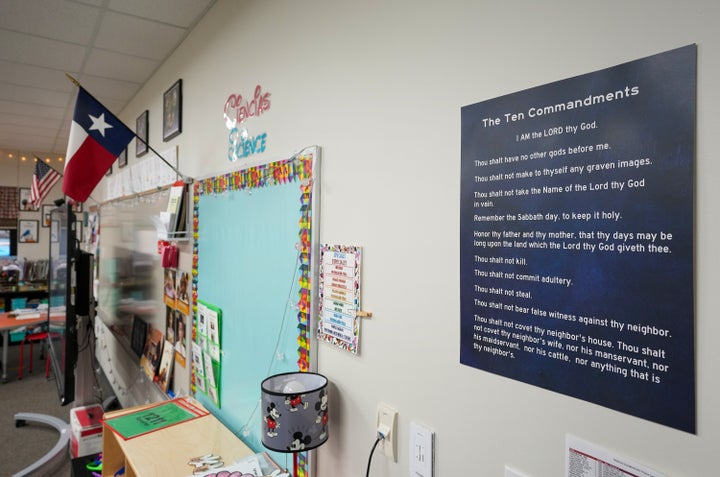
A Texas law mandating the display of the Ten Commandments in every public school classroom has received judicial backing, marking a significant moment for advocates of religious presence in public life. The Fifth Circuit Court of Appeals upheld this controversial legislation on Tuesday, igniting debates about the implications for church-state separation.
This ruling challenges decades of established legal precedent, particularly the First Amendment's establishment clause, which prohibits government endorsement of religion. In 1980, the Supreme Court ruled that public schools could not be compelled to display the Ten Commandments, citing a violation of this clause.
“The First Amendment safeguards the separation of church and state, and the freedom of families to choose how, when and if to provide their children with religious instruction,” stated a coalition of civil rights and religious freedom organizations that challenged the law. “This decision tramples those rights.”
Critics of the ruling have voiced strong objections. “What used to be considered a wall of separation between church and state has turned into a small speed bump,” remarked Seth Chandler, a law professor at the University of Houston, in an email. Others echoed similar sentiments, arguing that this decision undermines long-standing legal principles.
Ira Lupu, a constitutional law expert at George Washington University, expressed his dismay: “I think it’s a terrible decision. They’re just trying to erase Supreme Court precedent.” Michael Helfand from Pepperdine University added, “The historical record provides evidence that when government acts to manipulate the religious preferences of its citizens, it violates the establishment clause.”
Supporters of the Texas law contend that the Ten Commandments are integral to U.S. history and do not violate the establishment clause. The Fifth Circuit ruled that the mandate does not infringe on parental rights regarding their children's religious beliefs. “No child is made to recite the Commandments, believe them, or affirm their divine origin,” stated the court in its opinion.
However, Lupu countered this argument, saying, “The Fifth Circuit fell back on the idea that it’s passive. But it’s on the wall in every class, every day, from kindergarten until graduation. It will be constant and pervasive.”
Governor Greg Abbott signed this contentious bill into law last June, prompting immediate legal challenges from various organizations and parents representing diverse faiths. While some districts have complied with the law, others have faced lawsuits from Republican Attorney General Ken Paxton for non-compliance.
The legal battle is far from over. Organizations like the ACLU of Texas plan to escalate their challenge to the Supreme Court. “There are some dangers there. If the Supreme Court takes it and they lose, now it’s a nationwide ruling,” Lupu warned.
Similar legislative efforts have emerged across several states. Louisiana, Arkansas, and Oklahoma have all introduced bills requiring schools to display the Ten Commandments. While Arkansas’ bill was struck down by a lower court and Oklahoma’s failed in the legislature, Louisiana’s law went into effect in February after a Fifth Circuit ruling deemed insufficient evidence existed to determine its constitutionality. Ohio is also advancing legislation allowing public schools to display the Ten Commandments alongside other historical documents.
The Supreme Court has recently addressed issues surrounding religious beliefs in educational settings. In a notable case last year, parents in Montgomery County, Maryland, sued over their inability to opt out of lessons featuring LGBTQ+ themes, claiming it infringed upon their religious beliefs. The court sided with the parents, asserting that their religious views took precedence over public school curriculum.
Should the Supreme Court take up the Ten Commandments case and rule against objecting parents, it would create a direct contradiction with Mahmoud v. Taylor in Maryland—suggesting these cases may prioritize Christianity in schools over protecting religious liberty.
“You can’t opt out of a rule that requires a poster in every single classroom,” Lupu emphasized. “Maybe there is going to be way more room for religion in public school than there’s been since the 1960s,” he concluded.