


WASHINGTON – A straightforward inquiry looms: Did Donald Trump lose the presidential election in 2020? The answer is unequivocally yes; Trump was defeated by Joe Biden.
Yet, Trump’s struggle to accept this reality has morphed into a troubling trend among his nominees for key government positions. A significant number of these individuals are evading the question of his loss, with many contorting their responses to avoid a direct acknowledgment.
Demand Justice, a progressive judicial advocacy organization, has scrutinized the responses of Trump’s 40 nominees for lifetime federal judgeships. Their findings reveal a pattern of misleading or ambiguous answers regarding the 2020 election during Senate Judiciary Committee hearings. Instead of simply affirming Biden's victory, nominees often reference Biden’s “certification” by Congress or state that he “served” as president, sidestepping the crucial point of his actual win.
This tactic mirrors the longstanding approach of Republican lawmakers who have refrained from publicly contradicting Trump’s claims about the election. “Our theory from the beginning was that this was a litmus test for Trump,” remarked Josh Orton, president of Demand Justice. “These district judges are announced on Truth Social; they know they could have their nominations pulled just as quickly on Truth Social.”
Orton’s comments highlight the influence of Trump’s social media platform, where he frequently makes headlines or expresses outrage at odd hours. The nominees’ reluctance to state that Biden won in 2020 reflects their allegiance to Trump and their complicity in perpetuating falsehoods about the election.
Moreover, nominees have also dodged another critical question: “Was the U.S. Capitol attacked by a violent mob on January 6, 2021?” Demand Justice's analysis indicates that none of Trump’s judicial picks have answered affirmatively. Instead, many have described the events of that day as merely “a political debate” or “political issue.”
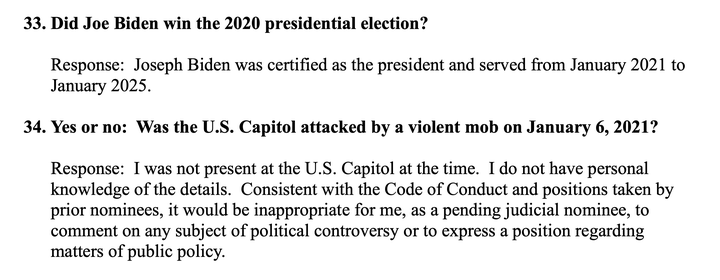
Maria Ann Lanahan, one of Trump’s confirmed judges on the U.S. District Court for the Eastern District of Missouri, provided an even more perplexing response: “I was not present at the U.S. Capitol at the time. I do not have personal knowledge of the details.”
As hearings for high-level administration posts unfold, nominees continue to provide similarly convoluted answers. During his confirmation hearing last month, Homeland Security Secretary Markwayne Mullin avoided a direct response when asked by Sen. Elissa Slotkin (D-Mich.) about the 2020 election outcome.
“Ma’am, we know that President Joe Biden was sworn into office,” Mullin stated, deflecting the question. This pattern repeated itself recently when Sen. Elizabeth Warren (D-Mass.) questioned Kevin Warsh, Trump’s nominee to the Federal Reserve.
“Mr. Warsh, did Donald Trump lose the 2020 election?” she inquired. Warsh responded evasively, “Uh, we try to keep politics, if I’m confirmed, out of the Federal Reserve.” After further prompting, he sidestepped again: “I believe that this body certified this election many years ago.”
The trend of evasion has become so pronounced that Sen. Chuck Grassley (R-Iowa), chairman of the Senate Judiciary Committee, addressed it directly during a recent hearing. He criticized Democrats for their persistent questioning of nominees regarding the election outcome.
“Under our constitutional system, whoever is certified as receiving the majority vote from the Electoral College is the winner of the election,” Grassley asserted. He dismissed Democratic inquiries about the popular vote as unnecessary since none of the nominees counted ballots.
Orton found humor in Grassley’s defense, noting, “You can tell what a problem it’s become if Grassley is trying to prebut it before the questions start.” He emphasized that even by Grassley’s own standards, these nominees have failed to provide clear answers.
During the same hearing, Sen. Dick Durbin (D-Ill.) pressed U.S. appeals court nominee Justin Smith on whether Trump lost the 2020 election. Smith’s responses were convoluted and avoided a direct answer.
“Will you acknowledge that President Trump lost the 2020 election to Joe Biden?” Durbin asked pointedly. Smith replied with a focus on procedural details rather than addressing the question directly.
“At some point, there is going to be a video I’m sure that will be released [in] which we’ll watch the painful explanation by every nominee from the Trump White House for the federal bench as to why they couldn’t answer the basic question every single person in this room knows is true,” Durbin remarked.
“Donald Trump lost the election in 2020 to Joe Biden. He may have regretted it. He may have denied it, but it’s a fact,” he concluded. “The reason we continue to engage in these political gymnastics is a question about whether or not you can ever say no to Donald Trump when it comes to any future service. And that is a basic concern.”