



Trump's Health Agency Cuts Spark Outrage Amid Deadly Hantavirus and Ebola Outbreaks
The Trump administration's savage cuts to federal health agencies have ignited a political firestorm, coinciding with a deadly hantavirus outbreak aboard a cruise ship and the alarming spread of Ebola in Africa.
Democrats are seizing the moment, claiming the U.S. is woefully unprepared for outbreaks, let alone a pandemic, after President Trump slashed jobs and funding for public health infrastructure and pandemic readiness. Infectious disease experts demand the White House reverse these cuts and rejoin the World Health Organization.
The White House scrambles to reassure a pandemic-weary public that it can still effectively tackle infectious disease outbreaks.
Massive layoffs at the Food and Drug Administration and the Centers for Disease Control and Prevention resulted from an initiative led by billionaire Elon Musk and the Department of Government Efficiency, or DOGE, which also axed billions in federal contracts and grants.
"These outbreaks are unfolding at a time when the U.S. public health infrastructure is under significant strain," stated Leana Wen, an emergency physician and former Baltimore health commissioner. "The CDC currently lacks a director, the FDA lacks a director, there is no surgeon general, and many leaders with outbreak response management experience have left the federal government."
The U.S. government has ordered quarantines and is monitoring potential hantavirus exposures after an outbreak on a cruise ship. New restrictions for foreign travelers are being implemented amid an Ebola outbreak in the Democratic Republic of Congo and Uganda, which has surpassed 1,000 suspected cases. While neither situation is deemed likely to escalate into a global pandemic, Democrats and infectious disease leaders are using these outbreaks to hammer the effects of DOGE cuts and other public health policies.
The hantavirus cluster erupted on the MV Hondius, an expedition ship that departed Argentina on April 1 with nearly 150 passengers. The earliest cases, including two fatalities, were reported to the WHO on May 2. Three of 11 infected passengers have died. Hantavirus typically spreads from rodents, but this variant, known as the Andes virus, can transmit between people.
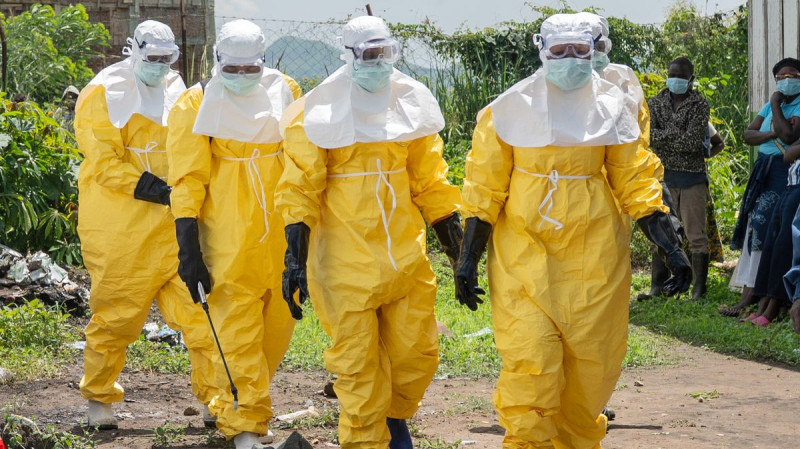
The Ebola outbreak has captured public attention, although no cases have been confirmed in the U.S. The virus—a rare strain called Bundibugyo—has no proven vaccines or treatments and spread undetected for weeks. WHO Director General Tedros Adhanom Ghebreyesus expressed concern about the "scale and speed" of the outbreak. Seven Americans, including a doctor exposed to the virus, were evacuated to Germany by the U.S. State Department.
Some Democrats are pushing for the administration to rejoin the WHO and restore funding to federal agencies. A lawsuit is ongoing regarding the dismantling of the U.S. Agency for International Development, which was crucial for providing foreign assistance. Core USAID activities included building local outbreak detection and prevention capacity in vulnerable regions like the Democratic Republic of Congo.
Senator Chris Murphy (D-Conn.) highlighted emerging threats linked to rising Ebola cases, posting on X: "We know how to stop outbreaks like this. But Trump chose not to stop it. He destroyed our global health team, deliberately exposing us."
Senator Dick Durbin (D-Ill.) criticized the Trump administration's "sweeping and self-destructive foreign aid cuts," stating they left both the U.S. and Congo struggling to contain the Ebola outbreak.
"An utterly predictable result from the chaos of DOGE," he remarked.
In light of the hantavirus outbreak, Senate Minority Leader Chuck Schumer of New York demanded that the administration rehire fired outbreak response workers, restore funding at the CDC and Department of Health and Human Services, and rejoin the WHO's global outbreak warning network.
"The Trump administration's gutting of America's public health preparedness has made the recent hantavirus outbreak even more alarming," Schumer declared on May 12 during a Senate floor speech.
Federal agencies have pushed back against criticisms regarding their early response to hantavirus, asserting through social media, press events, and TV appearances that their actions were appropriate and effective.
The federal government is executing a coordinated interagency response, according to HHS spokesperson Emily Hilliard. Claims that federal cuts have jeopardized responses or future pandemic preparedness are "completely inaccurate," Hilliard asserted.
The CDC and State Department claim they are ensuring rapid viral testing is available for the Ebola outbreak while actively deploying resources through State Department offices in Congo and Uganda.
"I want to assure you that CDC and our federal partners are working around the clock to ensure our information is accurate and that action plans are being implemented immediately," said Satish Pillai, who leads the CDC's Ebola response, during a May 19 press call.
Criticism isn't limited to Democrats; public health officials also argue that actions taken by the Trump administration have hindered responses to both outbreaks. Cuts to USAID have set the stage for Ebola's spread.
The International Rescue Committee reported that funding cuts by the administration in March 2025 led to reduced disease surveillance systems in areas hardest hit by Ebola.
The U.S. previously funded surveillance and outbreak preparedness efforts aimed at preventing infections through hand-washing stations, showers, latrines, and waste management. The committee stated it had to cut programming due to funding reductions.
"Years of underinvestment and recent funding cuts have left many health facilities without adequate protective equipment, surveillance capacity, or frontline support needed to respond quickly and safely," Heather Reoch Kerr, country director for the committee in Congo, said in a statement.
The federal government's overall response to the outbreak—including its decision not to fly Americans exposed to Ebola back to the U.S. for treatment—contrasts sharply with previous responses to Ebola, according to some epidemiologists and former health officials. This could also deter other medical professionals from traveling to assist in the region.
During the 2014-15 outbreak in West Africa, the federal government deployed Army and Navy technicians along with other service members to process blood tests, build medical labs, and train local healthcare workers.
USAID emergency response teams played a vital role in that Ebola outbreak's on-the-ground response, from constructing treatment rooms to managing burials of deceased individuals, Ron Klain, Ebola czar during the Obama administration, stated on NPR.
Michael Osterholm, director of the Center for Infectious Disease Research and Policy at the University of Minnesota, emphasized that USAID was "a key support for programs."
"The infrastructure in Africa has been cut with the cuts at USAID," he noted. "It's making it more difficult."
The United States' ability to respond effectively to a real pandemic is "a mess" due to these cuts and the administration's stance on mRNA vaccines—the technology behind COVID shots—Osterholm added. The White House canceled nearly $500 million in contracts for mRNA vaccine development last year despite no evidence indicating any health risks.
This rapid technology would facilitate faster worldwide vaccine production during a pandemic compared to traditional vaccine development methods, Osterholm explained.
Health leaders have also criticized the U.S. response to hantavirus. For instance, on May 8, the CDC issued a health advisory regarding hantavirus cases on the cruise ship in the Atlantic; however, this alert came after some passengers had already arrived in the U.S. on commercial flights in late April.
The agency's first news conference about the MV Hondius outbreak occurred on May 9—five days after WHO alerted the public about it.
"The first press conference was after this was international news," remarked Wen, the former Baltimore health official.
The CDC defended its response to hantavirus by requiring U.S. passengers from the cruise ship to remain in quarantine facilities while assuring that overall health risks at home are low.
"The country is prepared. The CDC is focused on it," Mehmet Oz, physician and head of the Centers for Medicare & Medicaid Services, told reporters at the White House on May 11.
KFF Health News is a national newsroom that produces in-depth journalism about health issues and is one of KFF's core operating programs—the independent source for health policy research, polling, and journalism.