

Trump Administration Whitewashes Slavery Exhibit at Washington’s Historic Home
The Trump administration has yanked a slavery exhibit from President George Washington’s Philadelphia home, replacing it with a version that historians slam as a blatant whitewash of American history.
This exhibit was situated at the site where the Declaration of Independence was adopted on July 4, 1776.
Philadelphia Mayor Cherelle L. Parker condemned the action, stating, "Overnight, under the cover of darkness, the federal government removed panels at the President’s House that told a thorough history of Philadelphia." She added that the federal court allowed this move, but the nighttime execution reveals an understanding of its shameful nature and a violation of community trust.
The original panels, put in place in 2010, detailed the lives of nine enslaved individuals who resided with George and Martha Washington during the 1790s when Philadelphia briefly served as the nation’s capital.
This alteration comes amid President Donald Trump’s aggressive campaign to dismantle diversity and inclusion initiatives across America’s cultural and educational institutions.
In 2025, Trump issued an executive order mandating that federally owned historic sites refrain from displaying information that “disparages Americans past or living,” instead emphasizing the “greatness of the achievements and progress of the American people.”
Concerns have surged regarding the sanitization and erasure of America’s darker historical narratives.
Trump has launched a broadside against what he perceives as a liberal culture. In March, he announced plans to impose changes at the Smithsonian Institution through an executive order targeting funding for programs promoting “divisive narratives” and “improper ideology.” He has also pressured universities and other organizations to adopt similar measures aimed at eliminating what he claims are discriminatory practices.
The Trump administration first introduced the new panels earlier this year, but a lower court mandated their removal in February. However, a three-judge panel from the U.S. 3rd Circuit of Appeals overturned that decision on July 3, allowing the installation to proceed.
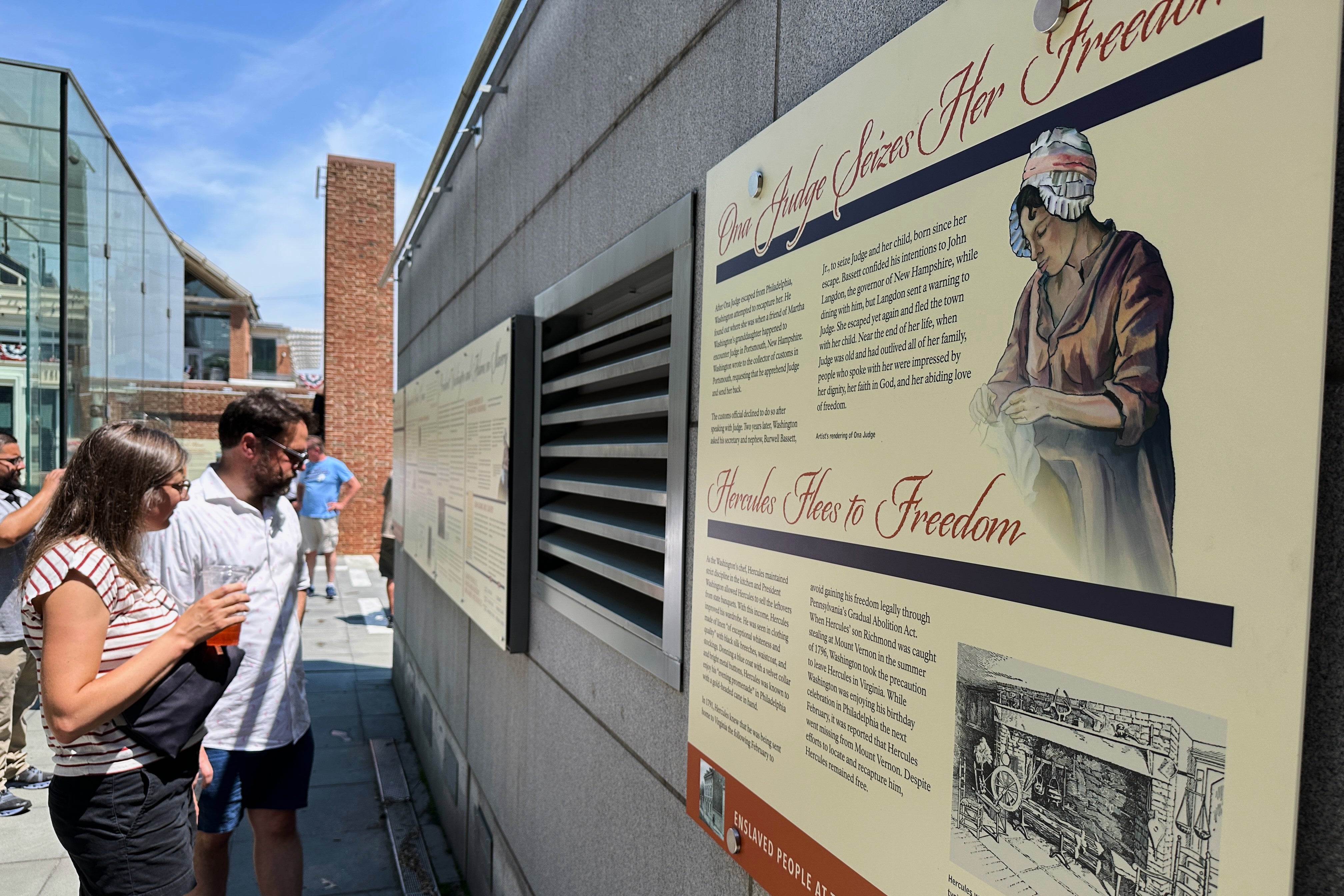
This panel praised the replacement plans as “full of historical context,” despite pushback from historians and city officials who argue that the content is sanitized.
The Interior Department stated that the new panels are rich in historical context and highlight significant events at the President’s House and other sites within Independence National Historical Park.
According to their statement, “They acknowledge the evils of slavery, including its injustices and hypocrisies, and, by telling the stories of the nine slaves that Washington kept in the President’s House, remind us of their essential humanity.”
A government website featuring images of the new panels indicates they will still address enslaved individuals who lived in the home. They will also cover details about the abolitionist movement, how slavery was treated in the Constitution, Pennsylvania's abolition timeline, and perspectives on slavery from Washington and his successor, John Adams, along with information about the 20th-century Civil Rights movement.
However, these replacement panels lack some critical details found in earlier versions, such as maps of slave trade routes and timelines on slavery. They also omit provocative headlines like “The Dirty Business of Slavery.”
The city of Philadelphia has filed a lawsuit against the federal government over the removal of previously included information. The city argues that federal authorities must consult with them before altering content at the President’s House Site. Justice Department lawyers contend that the administration alone holds authority over narratives presented at National Park Service properties.
Parker announced plans to seek a rehearing on “serious legal issues” raised by the appeals court ruling.
Michael Coard, an attorney and founder of Avenging The Ancestors Coalition (ATAC), stated that his Philadelphia-based history preservation group is actively pursuing legal strategies against the Trump administration’s alterations to the panels.
ATAC is part of the city’s lawsuit.
Coard accused Trump of attempting to rewrite history, questioning what might happen if future presidents target other historical symbols. “What if there’s a president next time who doesn’t like the Liberty Bell because the Liberty Bell was used by abolitionists to support the end of slavery?” he posed. “What if there’s a president who doesn’t like the Statue of Liberty because too many immigrants come in? Do we remove the Statue of Liberty?”