



Supreme Court Deals Devastating Blow to Transgender Athletes in Women's Sports
WASHINGTON — The Supreme Court just delivered a crushing verdict against LGBTQ rights, affirming state laws that bar transgender athletes from competing in girls' and women's sports.
In a sharply divided 6-3 decision, the court rejected challenges from two transgender students, Becky Pepper-Jackson and Lindsay Hecox, who fought against restrictive laws in West Virginia and Idaho.
Justice Brett Kavanaugh authored the opinion, asserting that these laws do not breach the 14th Amendment or Title IX of the Education Amendments of 1972, which prohibits sex discrimination in education.
Kavanaugh stated, “The Constitution and Title IX do not require an overhaul of women’s and girls’ sports throughout America.”
While he acknowledged the aspirations of transgender girls and women to compete, he emphasized that they should not be “ostracized or vilified.”
This ruling impacts not just West Virginia and Idaho but potentially affects 25 other states with similar bans.
“BIG WIN: The United States Supreme Court just RULED AGAINST MEN PLAYING IN WOMEN’S SPORTS,” President Donald Trump proclaimed on Truth Social, celebrating the decision.
West Virginia Governor Patrick Morrisey praised the ruling, asserting that it defends a principle understood by most Americans: women’s sports exist to provide fair opportunities for women and girls.
LGBTQ activists condemned the ruling, arguing that it undermines fairness while claiming to uphold it.
Sarah Kate Ellis, president of GLAAD, criticized the decision, stating it creates an unfair playing field for a small number of transgender students seeking to participate in sports alongside their peers.
Joshua Block, a lawyer with the American Civil Liberties Union representing the plaintiffs, called it a heartbreaking ruling for transgender girls who seek equal opportunities.
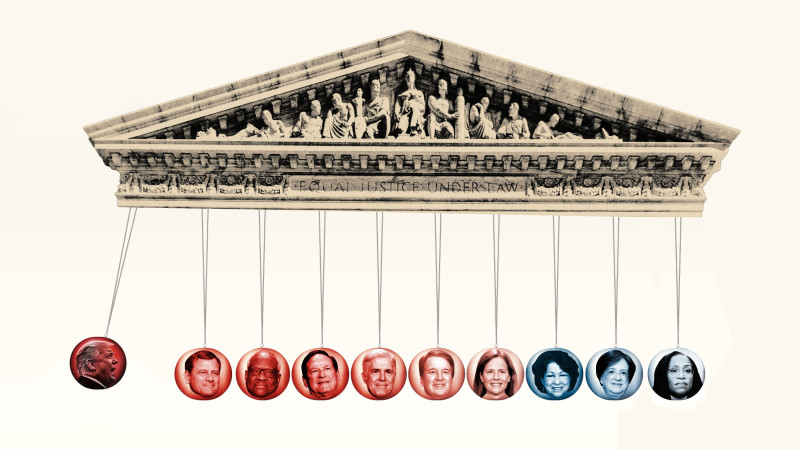
This marks yet another defeat for transgender individuals at the Supreme Court, which holds a conservative 6-3 majority.
Last year, the court upheld laws banning gender transition treatments for transgender youth. Earlier this year, it sided with parents opposing California policies designed to protect transgender students. The court also allowed Trump administration policies that barred transgender individuals from military service and restricted their gender identity on passports.

The ruling saw all six conservative justices in agreement while the three liberal justices dissented.
Justice Sonia Sotomayor, one of the dissenters, argued that the court imposes hardship on marginalized groups without granting them fair opportunities to contest their claims.
Sotomayor contended that Jackson’s case should have been sent back to a lower court for further examination.
She noted insufficient evidence to prove that transgender girls and women possess an “inherent physical advantage” across all sports.
In a previous ruling from 2020, the court surprisingly determined that Title VII of the Civil Rights Act of 1964 applies to gender identity and sexual orientation.
Pepper-Jackson, a high school sophomore, has undergone puberty-blocking medication and estrogen treatment while competing in girls' cross-country, shot put, and discus events.
Hecox, a college student, has received testosterone suppression and estrogen treatments. She attempted to join women's track and cross-country teams but was unsuccessful and has since participated in club soccer and running.
Transgender rights appeared to gain traction a decade ago; however, the current climate reflects a significant reversal.
Trump, an outspoken opponent of transgender rights, issued an executive order titled “Keeping Men Out of Women’s Sports” shortly after taking office last year.
The administration actively opposes state policies allowing full participation of transgender athletes in women's sports, even filing a lawsuit against California over the issue.
The International Olympic Committee announced in March that transgender women would be barred from competing in Olympic female sports categories moving forward.
The NCAA and the U.S. Olympic & Paralympic Committee have already implemented new restrictions on transgender athletes.
The West Virginia law, enacted in 2021, defines gender as “based solely on the individual’s reproductive biology and genetics at birth,” stating that a female is someone whose biological sex was determined as female at birth.
The Idaho law, passed a year earlier, similarly asserts that sports designated for females should not be open to students of the male sex.