


Trump's Algae-Filled Reflecting Pool: A Green Disaster of Epic Proportions
“Puke green” and “split pea soup” are the new descriptors for President Donald Trump’s algae-infested Lincoln Memorial reflecting pool, alongside catchy slogans like “Make Algae Great Again.”
Trump poured $14 million into upgrades for this iconic site, aiming for a sparkling blue pool. Instead, he got a murky mess after draining and painting it a shade he dubbed “American flag blue.”
Experts warned from the start. The New York Times highlighted the lack of infrastructure fixes for the pipes, making it clear that a mere paint job wouldn’t eradicate the persistent algae problem.
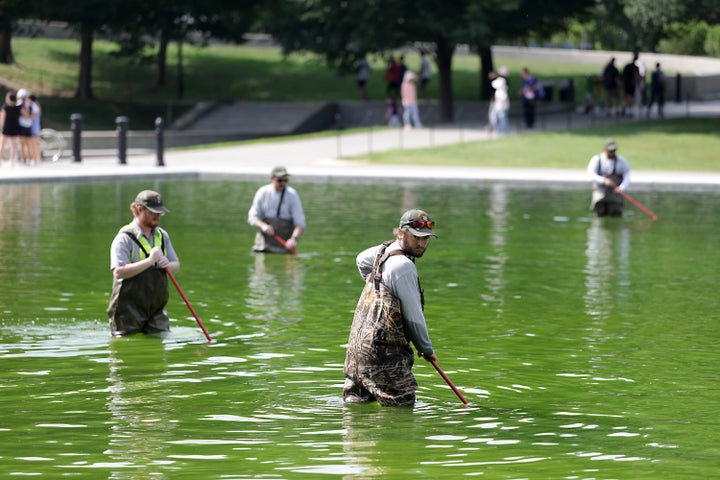
The algae situation is now undeniable. Workers scramble to control the bloom ahead of the 250th anniversary celebrations in Washington, D.C., set for July 4.
“Treatment of algae blooms is very costly and time-consuming,” said Sarah Goodrich, an adjunct professor at the University of Cincinnati. “We will have to see what happens before July 4.”
Multiple factors contribute to the pool's algae growth. “Algae blooms can occur when there are hot temperatures paired with stagnant water, in addition to high nutrient inputs such as nitrogen and phosphorus,” Goodrich explained.
Steve Goodale, owner of Swimming Pool Steve pool service, noted that natural plant matter growth occurs in any stagnant water, whether it’s a reflecting pool or a swamp.
“Swamps, and you know very well what they look like — green and full of growth and algae,” Goodale stated.
The reflecting pool holds approximately 6.5 million gallons of water. Managing algae in such a vast body is no small feat.
“There’s a ‘perfect storm’ of potential drivers here that could have caused the green explosion,” Goodrich added, especially with D.C.'s notorious heat.
Trump’s decision to paint the pool a darker color to mimic “American flag blue” has backfired. This change exacerbates the algae issue.
“It’s a massive surface area of a relatively shallow body of water, which was just changed to a darker color than it was previously,” Goodale explained. “If you take a body of water and you change it from a light color to a dark color, it will absorb more heat.”
This increased warmth directly correlates with more algae growth, he noted.
“They’re kind of fighting an uphill battle here,” Goodale said. “It’s not to say it won’t work; it’s just a harder process than it might appear.”
Goodrich pointed out that any algae present upon refilling the pool could thrive due to favorable weather conditions and increased sunlight.
Right-wing media and Trump supporters are concocting wild theories about sabotage by Democrats, claiming people are tossing algae into the pool. This notion is far-fetched.
Goodale dismissed the idea: “Algae is readily making its way into the pool already because of its open-air environment.”
“Nobody needs to add algae to my pool; I can still end up with algae in my pool,” he asserted.
“This is just a water chemistry situation,” he continued. “If you were to dump a wheelbarrow full of algae into it, it wouldn’t make any difference.”
Katie Martin from the Interior Department referred to the algae as “residual algae” from dormant pipes.
Goodale responded skeptically: “I wouldn’t know that that’s caused it... certainly, it would contribute if the lines were filled with algae and nobody cleaned those out.”
He emphasized that any contractor would be aware of such issues during maintenance. “If I take your pool offline for a month in the middle of summer, I can bet that any water remaining within the pipes is going to be super disgusting,” he said.
“So, maybe it is a contributing factor, but I think that water was very likely to turn green regardless,” he concluded.
Goodale acknowledged that a recently installed nanobubbler system aims to combat algae through ozone injection. This system is designed to create clean, healthy water without harming the environment.
“We’re just creating a mechanical version of that with an ozone system,” he explained.
However, environmental contamination from pollen and duck droppings remains a significant challenge.
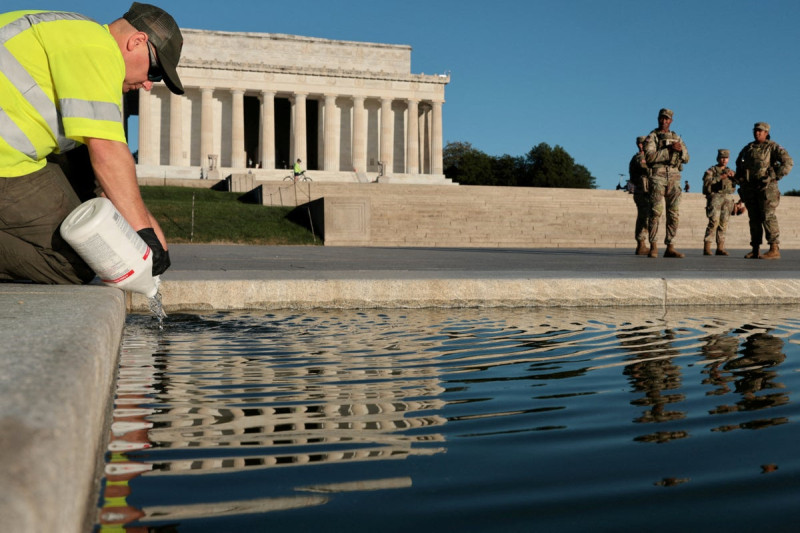
In an attempt to control the algae, workers were seen dumping hydrogen peroxide into the reflecting pool. Goodale warned that this likely won’t resolve the issue.
Hydrogen peroxide serves a similar purpose as the nanobubbler but is only a temporary solution, according to Hans W. Paerl, a research professor at the University of North Carolina at Chapel Hill.
“Hydrogen peroxide dissipates pretty quickly,” Paerl noted. “It actually turns into water... you’ve got to usually use multiple applications.”
The high percentage of hydrogen peroxide being used — 12% — could cause burns if animals drink from the water.
Goodale pointed out that significant quantities are necessary to impact 6.5 million gallons effectively.
A “tanker truck would be an appropriate size vessel” for hydrogen peroxide to make any real difference in the pool, he stated.
The fundamental issue remains: algae thrive in warm conditions. This is particularly problematic during D.C.'s hottest season.
“It’s usually a decrease in temperature that will dissipate the blooms,” Paerl explained. “Given climate change... these kinds of issues are only going to get worse.”
Algae blooms were once rare in Nordic countries but have surged due to rising temperatures linked to climate change.
“The window of opportunity for these blooms is expanding because of climate warming,” Paerl concluded.
A statement from Sarah Goodrich was updated to more accurately reflect potential causes of algae growth in the Reflecting Pool.