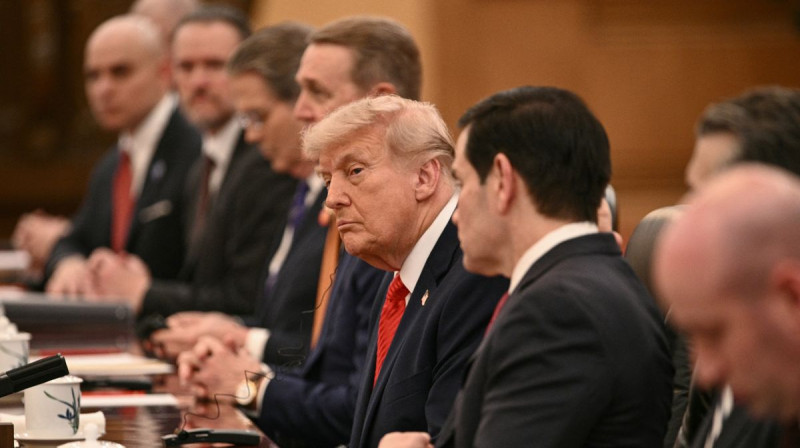


Chinese President Xi Jinping rolled out the red carpet for a powerhouse delegation of U.S. CEOs accompanying President Trump on his China visit, promising to further open the gates to American business. This is music to the ears of corporate titans like Apple’s Tim Cook, Tesla’s Elon Musk, and Nvidia’s Jensen Huang, who are itching to expand their empires in the world’s second-largest economy.
With a combined net worth nearing a staggering $1 trillion, these executives represent companies that have weathered years of trade disputes yet still see China as a goldmine. Despite tariffs soaring as high as 125% under Trump’s administration—after he accused China of “taking us for a ride”—the allure of China’s burgeoning middle class and vast consumer market remains irresistible.
The White House confirmed that these business leaders were part of a larger dialogue between U.S. and Chinese officials. “We discussed enhancing economic cooperation, including expanding market access for American businesses and boosting Chinese investments,” a White House official stated, hinting at potential breakthroughs.
Analysts from Eurasia Group suggest that this trip could lead to significant trade adjustments, particularly in non-sensitive sectors. Expect announcements about increased Chinese purchases of U.S. agricultural products, Boeing aircraft, and energy resources. The stakes are high, and the CEOs are ready to play their cards right.
Already, some CEOs are reaping rewards. Boeing’s Kelly Ortberg celebrated a deal for 200 Boeing 737 Max jets—an upgrade from an earlier agreement for just 50. Trump also revealed that Xi has committed to buying more soybeans, a much-needed lifeline for U.S. farmers who suffered when China halted purchases last year.
History shows that business leaders often accompany U.S. presidents on high-stakes trips. During Obama’s 2015 visit to India, a slew of CEOs joined him to foster trade relations. Bill Clinton did the same in 2000, bringing top executives from major corporations. Trump’s previous trip to China in 2017 featured leaders from major banks and tech firms.
“It’s not unusual for CEOs to travel with the president; it underscores the intertwined nature of U.S.-China relations,” said Mark Zandi, chief economist at Moody's Analytics. “Our economies are so closely linked that how we interact shapes global economic performance.”
The presence of these top executives could pave the way for smoother communication between U.S. companies and Chinese officials. Zandi noted that success doesn’t require monumental achievements—just establishing trust and open channels for dialogue.
However, it’s rare for executives like Musk and Huang to share Air Force One with the president, which raises eyebrows about potential conflicts of interest. Political scientist John Owen IV pointed out that while it’s a coveted opportunity, it also opens doors to corruption risks.
For these CEOs, the mission is clear: boost sales in China and secure vital manufacturing and trade agreements. Apple, the leading smartphone brand in China, faces fierce competition from local giants like Huawei and Xiaomi while relying heavily on Chinese partners like Foxconn for production.
Nvidia is eyeing broader access to China’s AI market as U.S. export controls threaten its chip sales. “What’s at stake is not just one trip but the future of AI supply chains and U.S. chip leadership in China,” said Wedbush analyst Dan Ives.
Financial heavyweights like BlackRock and Citigroup are also on this trade mission. BlackRock aims to tap into China’s wealth and retirement markets amid rising political scrutiny, while Citigroup seeks greater access to financial markets for cross-border transactions.
“There’s immense interest from investors wanting to understand China better,” Citigroup CEO Jane Fraser told Bloomberg News last year, highlighting the growing external focus of Chinese companies.
Among the executives is Jacob Thaysen from Illumina, the sole biotech representative on this trip. He lamented that export restrictions have hampered sales of DNA-sequencing technology in China. “We want to be part of China,” he declared, emphasizing the urgency of their mission.