

Supreme Court's Ruling on Voting Rights: A Local Level Game Changer
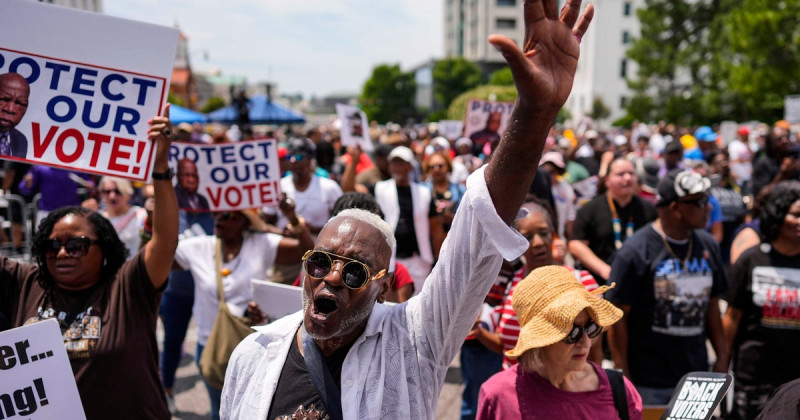
Marchers, including members of Delta Sigma Theta sorority, gathered in Selma, Alabama, in 2025 to honor the 60th anniversary of Bloody Sunday, a pivotal moment that led to the Voting Rights Act's passage. But now, the Supreme Court's recent ruling is sending shockwaves through local voting systems.
As Republican-led Southern states scramble to redraw congressional maps following the Supreme Court's gutting of the Voting Rights Act's protections against racial discrimination, the real impact is likely to be felt at the grassroots level.
Legal battles are heating up over at least 17 voting maps or election systems, with federal court records revealing a flurry of activity since the landmark decision in Louisiana v. Callais. Lawyers are racing to interpret how this ruling alters the application of Section 2 of the Voting Rights Act in redistricting.
The Supreme Court's conservative majority has shifted the focus of Section 2 to intentional racial discrimination—a standard notoriously hard to prove. Legal experts warn this change threatens minority representation and encourages rampant partisan gerrymandering across state legislatures, county commissions, and school districts.
In a direct fallout from the ruling, North Carolina state Rep. Rodney Pierce, a Democrat, recently dropped a lawsuit challenging the state's Senate map. He lamented that the Supreme Court has rendered the Voting Rights Act "a meaningless law with no teeth," stating, "It's a sad day for our democracy."
While many of these legal skirmishes are rooted in the South—where voting patterns starkly divide white majorities from Black minorities—cases are emerging nationwide. Latino voters are challenging Washington's legislative map, while Native American voters are fighting over North Dakota's districting.

All these cases now face a higher legal bar set by the Supreme Court for proving that voting districts dilute minority power. The stakes are high as challengers must now disentangle race from partisan preference to demonstrate racial polarization in voting—an uphill battle given the lack of partisan data at local levels.
"It's a mess," says Gilda Daniels, a law professor and former deputy chief in the Justice Department's voting section. The Trump administration's Justice Department has shifted its focus away from enforcing minority voting rights, dropping several cases initiated during the Biden era.
With the Supreme Court's ruling, local governments previously aligned with Section 2 protections may now feel emboldened to dismantle those safeguards. Daniels warns that vigilance is crucial as jurisdictions might consider moving from district-based elections to at-large systems, which could further marginalize minority representation.
Maureen Edobor, an assistant law professor, explains that at-large systems allow majority populations to dominate elections, effectively rendering minority votes irrelevant. "In racially polarized communities, this means the majority can win every seat," she asserts.
In Fayette County, Tennessee, local NAACP president Elton Holmes is bracing for more challenges. After a successful push for a new voting map that includes majority Black districts, he fears white commissioners may revert to gerrymandering if elections don't favor them. "It's just been a struggle," Holmes says. "We finally get a little breakthrough and then something else pops up to try to push it back some more."
Advocates are closely monitoring potential changes to state and local voting maps in light of the Supreme Court's ruling. Estimates suggest that nearly 200 Democratic-held legislative seats—predominantly representing majority-Black districts in the South—are now at risk of elimination.
The high court's future decisions could further undermine what remains of the Voting Rights Act, leaving advocates on edge as they prepare for an uncertain electoral landscape ahead.